From Discord to Harmony: The Unified Path to Orchestration Mastery
In our last post, we looked at the "IT Orchestration Train Wreck”, a world of siloed automation, tool sprawl, and vendor lock-in that drives up MTTR and leaves resources stranded. If the previous era of IT was a fragmented orchestra playing out of tune, the future belongs to the Unified Path Forward.
To survive the complexity of modern multi-cloud and hybrid environments, organizations are moving away from "Islands of Automation" toward a Unified Orchestration Fabric. This isn't just about adding another dashboard; it’s about fundamentally changing how infrastructure communicates, scales, and heals.
Here is how we silence the noise and bring harmony back to the data center.
Global Inventory: Ending "Total Resource Blindness"

The first step toward unity is visibility. A unified orchestration platform pulls data from every vCenter, every cloud provider, every storage array and every networking element into a single source of truth.
The Impact: Instead of checking five different consoles to see if you have enough RAM for a new project, you have a global view of all assets.
The Result: You eliminate "stranded capacity." If your Development cluster is sitting at 20% utilization while Production is red-lining at 95%, a unified path allows you to see and bridge that gap instantly.
Cross-Domain Intelligence: The End of the Blame Game
In a siloed world, the network team says "it’s the app," and the app team says "it’s the storage." Unified orchestration uses relationship mapping to understand how a VM in vCenter A relies on a LUN in Storage Array B and a VLAN in Network Switch C.
The Impact: When a performance lag occurs, the system doesn't just alert you; it shows you the "blast radius."
The Result: Root Cause Analysis (RCA) moves from hours of manual guessing to seconds of automated insight. This is the "Silver Bullet" for crashing your MTTR.
Policy Orchestration: Defeating Configuration Drift
Security and compliance shouldn't be manual checkboxes that you hope stay checked. The unified path uses declarative policies; you define the "Desired State," and the orchestration engine enforces it across every silo.
The Impact: If a security hardening rule is updated in your primary data center, the unified fabric automatically propagates that change to your edge locations and cloud instances.
The Result: No more "Inconsistent Policies." Your security posture remains identical across the entire enterprise, regardless of the underlying vendor.
IT Operations; Metrics Reimagined
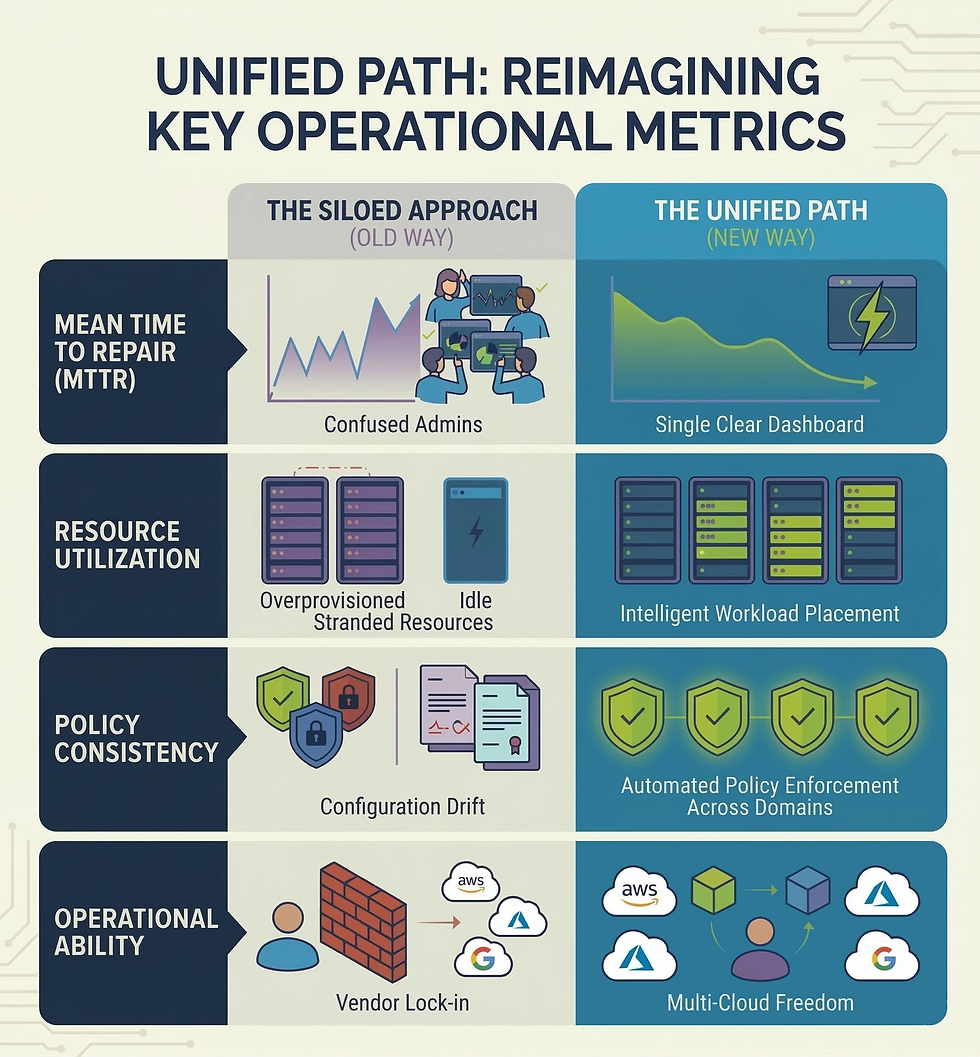
When you transition from the "Train Wreck" to the "Unified Path," the operational metrics we tracked in the last blog begin to flip. Here is what happens to your KPIs:
Metric | The Siloed Result (Old Way) | The Unified Result (New Way) |
MTTR | Increasing. Admins are lost in "Context Switching Fatigue." | Decreasing. Rapid automated remediation and clear RCA. |
Resource Utilization | Inefficient. Massive idleness and over-provisioning. | Optimized. Intelligent workload placement and balanced clusters. |
Policy Consistency | Widening Gaps. Configuration drift creates risks. | Tightened. Automated enforcement across all domains. |
Operational Agility | Paralyzed. High technical debt and vendor lock-in. | Accelerated. Multi-cloud freedom and "Single Pane of Glass" hybrid cloud control. |
Breaking the Garden Walls
The ultimate goal of the unified path is Multi-Cloud Freedom and moving towards a true hybrid cloud orchestration. By abstracting the orchestration layer away from the proprietary "walled gardens" of hardware vendors, you regain the power to choose.
You are no longer stuck with an overpriced stack because "that’s where the orchestration lives." Instead, your orchestration lives above the stack, allowing you to move workloads to the most cost-effective, high-performance environment available at any given moment.
The Bottom Line: Unified orchestration turns your IT infrastructure from a liability into a competitive advantage. It moves your team from "firefighting" to "innovating."
The Mechanics of Federated Orchestration
To move beyond the "Garden Walls" of proprietary vendors, the Unified Path relies on a sophisticated Orchestral.ai Solution composed of three core pillars. These engines work in concert to provide true Federated Orchestration:
The Discovery Engine: This is the "brain" that provides 360-degree visibility. It continuously scans your entire estate—on-prem, edge, and cloud—to build a real-time inventory of every asset, ending resource blindness for good creating a single source of truth.
The Resource Arbitration Engine: This acts as the "judge," intelligently balancing workloads across your distributed vCenters and clouds. It ensures that no single silo is over-burdened while others sit idle, maximizing your ROI and hardware efficiency.
The Integrated Cross-Domain Orchestrator: The "conductor" of the fabric. It bridges the gap between storage, compute, networking, and security allowing for automated remediation and policy enforcement that spans across vendor lines and geographic boundaries.
By integrating these three engines, organizations finally achieve a Unified Path Forward, transforming a chaotic collection of silos into a high-performance, federated enterprise.
The next blog in the series focuses on the Orchestral Solution with these three engines and also highlight the customer benefits achieved by the solution.