The Conductor’s Baton: Turning Vision into Reality with the Orchestral Suite
In our previous posts, we identified the "IT Train Wreck" and outlined the blueprint for a Unified Orchestration Fabric. But a blueprint is just paper; to bridge the gap between "fragmented silos" and "seamless harmony," you need the right machinery.
Today, we introduce the technologies needed to achieve the Unified Orchestration Fabric, the engine room of the modern data center. While others offer dashboards, we offer a trio of powerhouses designed to discover, decide, and deliver.
Okay, let's explore these three technology pillars: Data Discovery, Intelligent Service Arbitration, and Cross-domain Orchestration.
Data Discovery
Orchestral’s Data Discovery and Delivery Engine(D3E) is the foundational process of identifying, cataloging, and understanding all the data assets within an organization's vast and often fragmented data landscape.
Core Technology: This technology typically involves a set of automated processes:
Scanning and Ingestion: Tools automatically connect to diverse data sources—including databases (SQL and NoSQL), file systems, data warehouses, data lakes, and even cloud storage buckets—and extract metadata about the files, tables, and streams they discover.
Metadata Extraction: It goes beyond just locating data; it identifies what kind of data it is (e.g., structured, semi-structured, unstructured), its schema, data types, and sizes.
Classification and Tagging: Advanced classification engines (often leveraging machine learning) analyze the content of the data to automatically identify sensitive information (like personally identifiable information, financial data, health records) or specific data types (e.g., customer data, log data) and apply descriptive tags.
Data Lineage and Relationship Mapping: This component tracks where data came from, how it's being used, and what other data it interacts with, providing a holistic view of data relationships.
Unified Catalog and Search: All of this discovered information is stored in a centralized, searchable data catalog, allowing users to easily find relevant, trustworthy data assets.
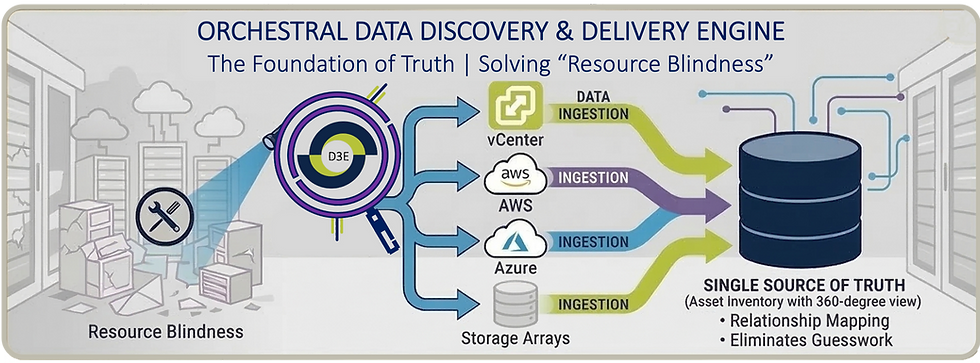
Instructive Visualization:
Understanding via Diagram: As depicted in the Figure1, data discovery involves scanning various sources, extracting information, and building a unified catalog, enabling visibility and understanding across your entire data ecosystem. The image shows the flow from disparate data sources through scanning and classification into a searchable, structured catalog.
Intelligent Resource Arbitration
Orchestral’s Resource Arbitration Engine(RAE), the Intelligent Resource Arbitration/Placement is the technology responsible for making automated, optimal decisions about where a particular workload or service should be deployed and executed across a potentially vast and diverse infrastructure environment (e.g., on-premises servers, public cloud, edge devices).
Core Technology: This intelligent capability is driven by:
Policy-driven Decision Making: It evaluates service placement based on a comprehensive set of predefined policies. These policies can be related to performance (e.g., minimum latency, maximum throughput), cost optimization (e.g., placing on the cheapest instance), compliance (e.g., ensuring data residency in a specific region), security, availability, and more.
Real-time Infrastructure Monitoring: The system continuously collects real-time telemetry and state information from all potential infrastructure targets, including current resource utilization (CPU, memory, storage, network), costs (using spot instances, dynamic pricing), network conditions, and health status.
Advanced Analytics and AI/ML: Sophisticated algorithms and machine learning models analyze both the service requirements and the real-time infrastructure metrics. They predict performance and cost implications of placing a workload in different locations and use this analysis to make intelligent, proactive placement decisions, rather than just reactive ones.
Abstraction and Orchestration Integration: The placement technology is typically decoupled from the underlying infrastructure, allowing it to evaluate options across different cloud providers, data centers, etc., generically. It then communicates the decision to orchestration tools that execute the actual deployment.
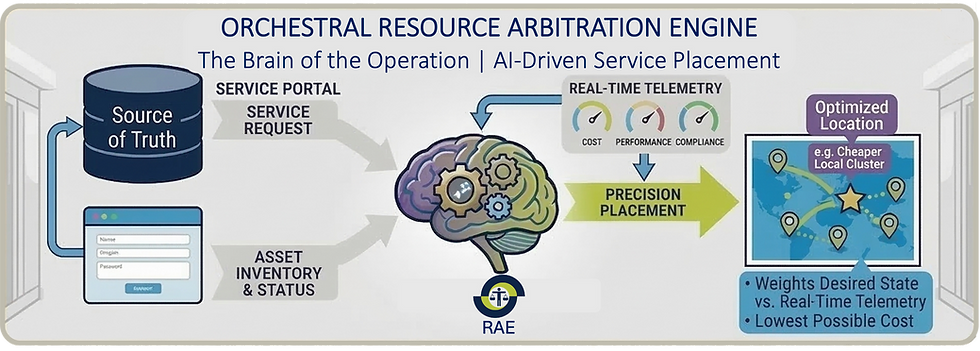
Instructive Visualization:
Understanding via Diagram: The Figure 2 visualizes how an intelligent placement mechanism continuously evaluates infrastructure options and places services based on defined criteria, continuously refining these decisions. It clearly separates the input factors (policies, real-time metrics) from the decision engine, which then guides service deployment across different infrastructure options.
Cross-domain Orchestration
Orchestral’s Composer, an event-driven, cross-domain orchestration platform involves automating and managing workflows, services, and complex processes that span multiple heterogeneous, siloed domains within an IT organization. These domains could be different cloud providers, data centers, network segments, security zones, application stacks, or vendor technologies.
Core Technology: Key components enabling cross-domain orchestration are:
Workflow Automation and Management: Central to this technology is a powerful orchestration engine capable of defining, modeling, and executing complex, multi-step workflows. These workflows can be visually designed or specified in code, incorporating conditions, loops, error handling, and parallel tasks.
Abstraction and Connectors/Adapters: A crucial element is abstraction. The orchestrator doesn't directly interact with domain-specific APIs for every task. Instead, it uses a generic interface and a library of connectors or adapters that translate generic orchestration commands into the specific actions required by individual domain managers (e.g., specific cloud APIs, network controllers, server provisioning systems).
Unified Control Plane: It provides a single point of visibility and control for managing resources and processes across all connected domains. This dashboard or central interface allows IT operators to define cross-domain workflows, monitor their progress, and troubleshoot any issues from one central location.
Security and Policy Enforcement: Crucially, cross-domain orchestrators must ensure consistent security and policy enforcement across all affected domains. They manage identities, permissions, and security controls, ensuring that automated actions comply with overarching security and governance policies.
State Management and Idempotency: The orchestrator maintains the state of resources across domains and ensures that automated operations are idempotent (meaning that repeating an operation has the same effect as doing it once), preventing unintended consequences from re-running failed steps or multiple orchestration attempts.

Instructive Visualization:
Understanding via Diagram: As shown in Figure 3, the architecture diagram, cross-domain orchestration provides a centralized control plane to automate workflows that touch multiple, previously siloed infrastructure domains, unifying control and operations. The diagram illustrates a central orchestrator connecting via adapters/connectors to distinct, named domains, and then executing workflows that traverse these boundaries.